

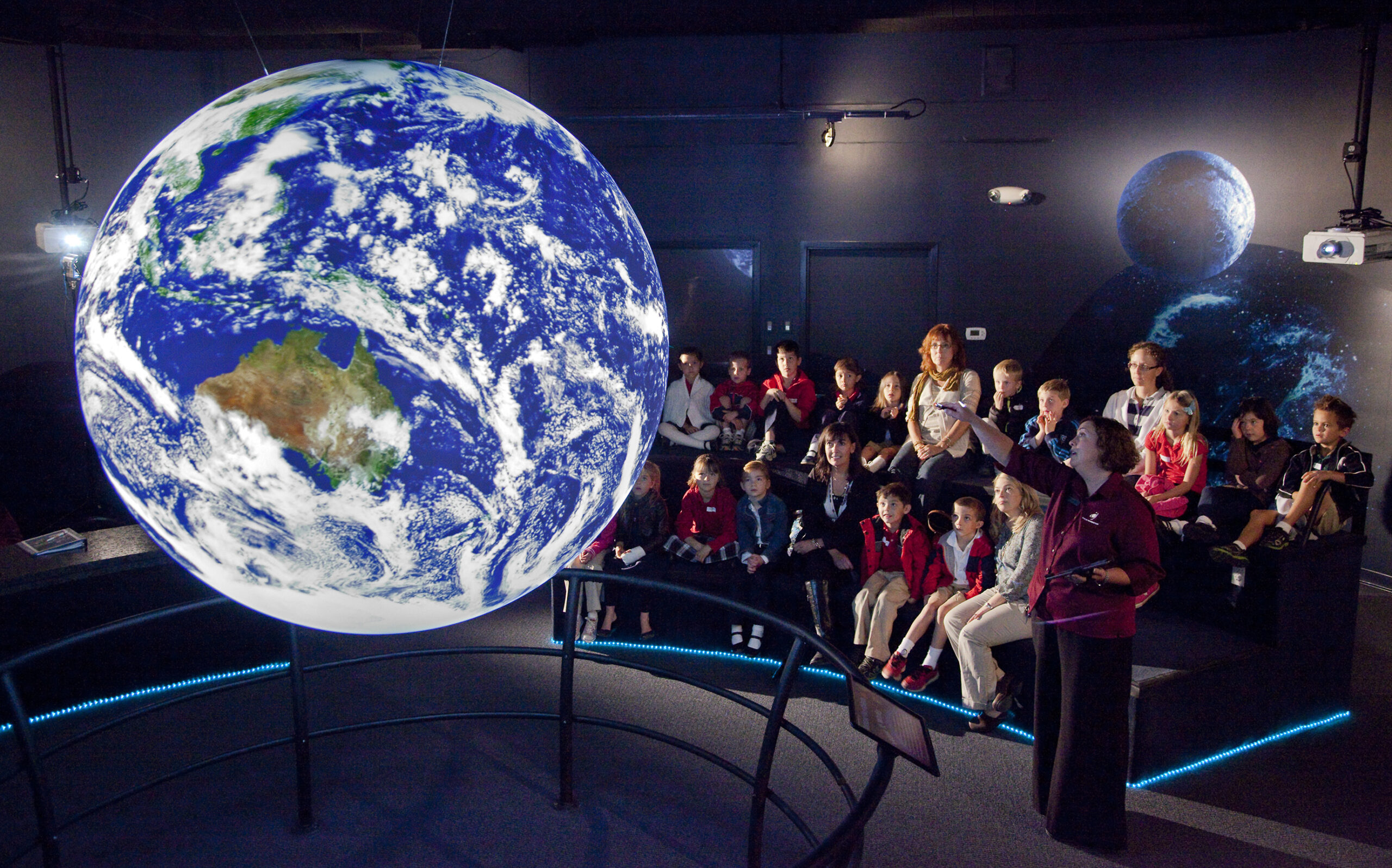
SCIENCE ON A SPHERE DEMONSTRATION, Photo Credits: NOAA
Entering the second floor of the IMAG History & Science Center, we are immediately faced with a giant spinning globe, a big, beautiful, “blue marble,” as if we are in outer space, miles away yet traveling in an orbit around the Earth. We recognize the place we call home, our world, gently turning on its axis, glowing brightly against the walls and ceiling of black, as if it is suspended in space. And look, there is North America and the Atlantic Ocean and look again, we see the United States; oh, yes, and there’s Florida drifting by as the big, beautiful globe turns. We are in awe. Welcome to Science On a Sphere at the IMAG History & Science Center.
Science On a Sphere (SOS) is a giant global display system that projects visualizations of planetary data onto a six-foot diameter sphere to help illustrate the science of the Earth and our solar system to guests of all ages. It’s fascinating, it’s informative, and it’s fun. But how is this six-foot globe spinning when it appears to be suspended in space? And now, we see as our eyes adjust to the dark space, that it is not spinning, it is stationary, and there are images projected on the sphere from four synchronized projectors creating an illusion of spinning, of motion, of a giant globe turning on its axis.
Researchers at the National Oceanic and Atmospheric Administration, also called NOAA, (visit them at https://www.noaa.gov) developed Science On a Sphere as an educational tool to illustrate Earth science with animated images of climate change, atmospheric storms, and ocean temperatures, as well as other weather-related, people-related, and Earth event-related topics. SOS is used to educate and explain these and many other topics in a way that is inspiring, intuitive, fun, and engaging.
Science On a Sphere, a registered trademark of NOAA, is an extension of NOAA educational program goals designed to increase everyone’s understanding of the Earth, its people, animals, and environment as well as our solar system. Using its collective experience and knowledge of the Earth, its land, oceans, and atmosphere, NOAA’s Science On a Sphere is an exciting and interesting display to enhance educational programs in science centers, universities, and museums like the IMAG History & Science Center. Many of the programs or presentations on the SOS are real-time animations of current or recent events, like tracking the path of a hurricane, something that we are all too familiar in Florida, in the Atlantic Ocean, Gulf of America, or Caribbean Sea.
Let’s, however, take a closer look at this great display and get into the fun of it all. To begin with, the SOS has a hands-on, touch screen control for guests to easily and simply operate and explore its various topics. You start by selecting a category of interest from which you can choose a specific topic. SOS categories include topics related to air, water, land, snow and ice. They also include topics about people, a favorite with many, and about space as well; there are other popular topics and movies too. Because you have so many categories from which to choose, the best way to explore the SOS is to simply pick a category and find a topic that interests you. For example, you can choose the category, people, and in that you can explore air traffic, touch the screen, and the image of the big, beautiful, blue marble changes promptly to hundreds and hundreds of airline flights, travelling to various destinations, around the world in real time. Or, if you want to be truly amazed again, choose Facebook friendships and the image plots thousands and thousands of connections in a giant, inconceivably complex, web of friendships. Or you can check out information regarding flu and virus transmission worldwide, or other topics, and more; there are several in each category.
Having too much fun yet? You will also want to check out some other topics like bird migration or turtle migration around the world. Or perhaps you might want to look at cloud coverings around the world, or earthquakes, or changes in atmosphere, or you might even want to explore the moon and other planets. There is so much to learn and explore. What’s more, the SOS offers you some neat features and controls you’ll want to check out. Do you want to get a better look at Finland or New Zealand? Roll and rotate the big blue marble. Do you want to identify borders or land masses? Make your selection on the touch screen and voila. Do you want to identify countries, capitals, and other cities? Make another selection and up on the sphere, these overlays of information appear just like that.
And now, that you’ve been introduced to Science On a Sphere, the bigger question is how to put a limit on your SOS fun. The IMAG History & Science Center is open 10:00 AM to 5:00 PM Monday through Saturday and 12:00 PM to 5:00 PM on Sunday and closed on Tuesday. The IMAG History & Science Center is located at 2000 Cranford Avenue, Fort Myers, FL 33916. For more information, 239-243-0043 or theIMAG.org.
Love what you're reading?
Get the best of Fort Myers delivered to your inbox every month — local stories, events, and good news worth sharing.
Subscribe for Free