
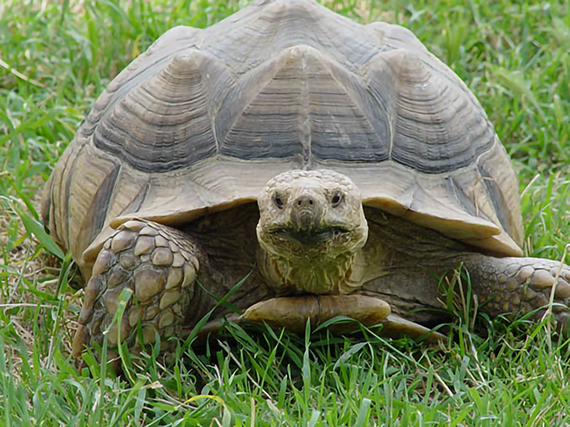
PERCY, THE AFRICAN SULCATA TORTOISE
At the IMAG History and Science Center, guests are often excited to visit The Living Lab. It’s an interesting, fun, and inspiring environment for learning about the many different animals that call IMAG “their home” including reptiles, amphibians, and fish. There are, for example, different species of turtles and tortoises, frogs and toads, lizards and snakes, freshwater and saltwater fish, and more. There are also alligators and an epaulette shark and zebra moray as well. Today, however, we are visiting with the turtles and tortoises.
Guests often ask about the differences between the two. What makes a turtle a turtle and a tortoise a tortoise? One of the most notable differences is that turtles are aquatic or semi-aquatic animals whereas tortoises are terrestrial beings. And while turtles live in or near water like rivers, ponds, streams, lakes, and oceans, tortoises are strictly land dwellers. Another notable difference you will see in turtles and tortoises is the size and shape of their top shells called carapaces. Turtle shells are roundish and many are heart shaped. Usually, turtle carapaces are lower in height compared with tortoise shells which are much higher, elongated ovals. Tortoise shells look more like domes. And, while you compare the two, notice another difference between the two in the legs of some turtle species which have webbed feet for swimming, walking, and climbing or, in other turtle species, with their flippers for swimming. Now, compare turtle legs and flippers with those of tortoises which have sturdy, stout, elephant-like legs with their short scaly toes or claws for walking and digging in the dirt. And finally, if you are still unsure about the differences between turtles and tortoises, take a few to lunch. That’s right, their diets are unique. Although they are omnivores who occasionally enjoy aquatic vegetation, turtles prefer meat like savory worms, gooey insects, yummy amphibians, small fish, and birds. Conversely, tortoises are mostly herbivores; they dine on delicious salads of dandelions, leafy greens, vegetables, fruits, weeds, and grasses.
On second thought, you might not want to take one of IMAG’s tortoises to lunch. I’m talking about Percy. Everyone who visits The Living Lab want to see Percy but certainly not to take him to lunch. Percy is a rather large African Sulcata Tortoise known to originate from the Saharan Desert and Sahel Region of Africa. Also called Spurred Tortoises, African Sulcata Tortoises are the largest mainland species of tortoise in Africa and third largest in the world. Galapagos Giant Tortoises (from the Galapagos Islands off the coast of Ecuador, South America in the Pacific Ocean) and Aldabra Giant Tortoises (from the Aldabra Atoll of Seychelles Islands off the coast of Tanzania, Africa in the Indian Ocean) are larger. Be that as it may, Percy weighs in at about 100 pounds and is over two feet in length. He’s a big boy. African Sulcata Tortoises are not only large, but they also live a long life; their lifespans are from 70 to 150 years. During their lives, African Sulcata Tortoises, as land dwellers, dig burrows so they can access soil with a high-moisture content below the surface and spend the hottest part of their days in the burrows. Take a moment to visit Percy at his enclosure on the IMAG campus near the Red-Footed Tortoises’ enclosure. But don’t think about taking him to lunch. He is already well fed.
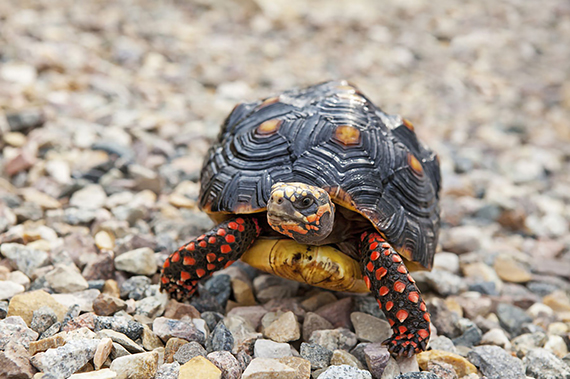
While you’re at it, stop in and see the Red-Footed Tortoises. They are much smaller in size averaging about 12 inches in length and weighing approximately 25 pounds each; a lot more manageable and a lot less heavy than African Sulcata Tortoises. Red-Footed Tortoises originate from Central and South America as well as from some of the Caribbean Islands. And as their name implies, these beauties are named for the vibrant red scales that are located on their legs. Besides their red scales, Red-Footed Tortoises also sport splashes of yellow. They have high-domed carapaces with pyramidal bony scales or plates (called scutes) with yellow centers, like dabs of paint. Scutes are hard, protective plates made of keratin (the same protein as human fingernails) that cover the bony carapaces of these tortoises. Acting like shields of armor, scutes help prevent injuries from predators. Generally, tortoises, unlike turtles, do not shed their scutes, rather they add layers which form the pyramidal rings you see on their carapaces. These rings on the tortoises indicate their growth. Speaking about growth, Red-Footed Tortoises live between 30 and 50 years of age. Besides red scales on their legs and yellow scutes on their carapaces, Red-Footed Tortoises also have large, thick, yellow bottom shells called plastrons. Like their carapaces, their plastrons or belly plates are composed of keratinous scutes over bone adding another layer of protection for their internal organs from rough terrain and predators. Tortoise plastrons are rigidly connected to their carapaces by a bony bridge located between their front and hind legs. Their top and bottom shells are firm, fixed, and secure. Like African Sulcata Tortoises, Red-Footed Tortoises also like to excavate burrows in the ground. So, when you visit their enclosure, look for some of their favorite places to rest. Most species of tortoises spend much of their time, about 50% of daylight hours, inactive, relaxing, staying in the same position, not moving, just resting. Red-Footed Tortoises tend to rest. If, however, you are looking for a bit more activity, head on over to the Florida Box Turtle enclosure and the Ornate Box Turtle enclosure and visit with these guys. Both enclosures are also near Percy’s place.
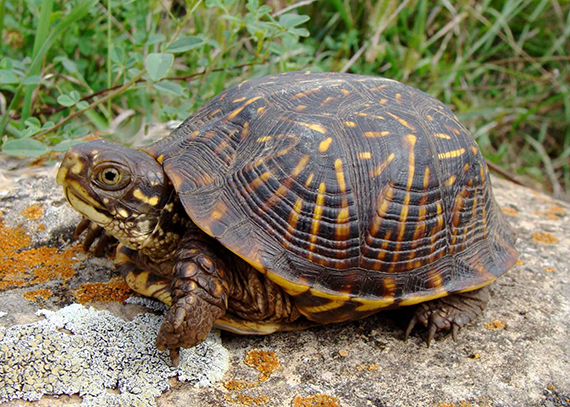
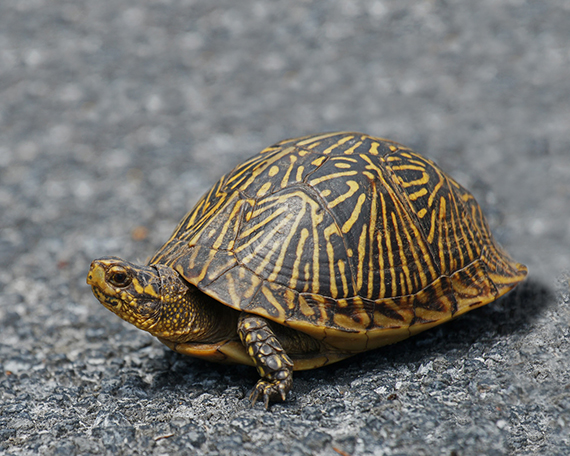
When guests visit these box turtles, they often want to know the differences between them. After all, they both look the same. Their carapaces look beautiful and similar in colors and patterns, their shell sizes are somewhat similar, and their legs and heads are similar too. So, how do we distinguish the Florida Box Turtle from the Ornate Box Turtle? It’s not enough to say one turtle is from Florida and the other is from… no, wait. That doesn’t work. How about, one turtle is Ornate and the other is… no; they’re both decorated and beautiful. Why don’t we just visit with them and discover their differences together.
Unlike the size differences between the African Sulcata Tortoise and the Red-Footed Tortoise, the Florida Box Turtle and the Ornate Box Turtle carapaces are somewhat the same size from about four to six inches in length. But if we look closely, the Florida Box Turtle shell is slightly larger, more oval, and a slightly higher dome. The Ornate Box Turtle shell is rounder with a slightly lower dome. True, the patterns of yellow on the shell’s background of dark brown are somewhat alike especially with their center lines and radiating, starburst markings but, when we compare the shapes and sizes of the top shells without the influence of pattern similarities, we can spot some of those slight differences. Both species weigh in at about one to two pounds, give or take eight ounces, due likely to differences in the carapaces. If we compare the heads of Florida Box Turtles with Ornate Box Turtles, we see other differences in their shapes and markings. Notice, for example, how Ornate Box Turtles have squarish snouts with no markings on their heads while Florida Box Turtles have roundish snouts with two yellow stripes on their heads. And now while we are taking a closer look, we see a distinct difference in their hind feet. Whereas Florida Box Turtles have three toes, an adaptation likely suited to wooded habitats for navigating soft, moist soil and forest debris, Ornate Box Turtles are given four toes for better mobility in open prairie environments. The fourth toe provides Ornate Box Turtles with added stability and traction. An additional distinction also worth mentioning is Florida Box Turtles have a longer lifespan than Ornate Box Turtles from 50 to 70 years compared with 30 to 40 years. Finally, one of the most important differences between these turtles can be seen in their bottom shells. Both species possess a unique, hinged plastron that allows them to completely seal their limbs and head inside their enclosed top and bottom shells. Both species possess this hinged mechanism behind their front legs to create a “protective box” against predators. Thus, the name, Box Turtles. The difference, however, is observed in the bottom shells of the turtles. Plastrons of Florida Box Turtles are plainly and simply yellow while plastrons of Ornate Box Turtles are ornately patterned, a very noticeable difference you would see clearly if you were to turn both turtles over and compare them. However, we kindly ask you not to do that. Our turtles are most happy upright… just to stand on their own four feet.
As if you haven’t had enough tortoises and turtles, you might also want to visit Earnie’s Estuary, a large lagoon at the IMAG, situated near the turtle and tortoise enclosures where there are other species of turtles including Florida Softshell Turtles, Suwannee River Cooters, Peninsula Cooters, Yellow-Bellied Sliders, and more. Here, you are invited to purchase some “fish ‘n’ turtle food” and provide a hearty lunch for these hungry turtles and their fellow fishes. Bon appétit!
The IMAG History & Science Center is located at 2000 Cranford Avenue, Fort Myers, Fl 33916. For more information, 239-243-0043 or theIMAG.org. The IMAG is open Monday through Saturday from 10:00 AM to 5:00 PM, Sunday from 12:00 PM to 5:00 PM, and closed Tuesday.
Photo Credits: IMAG History & Science Center
Love what you're reading?
Get the best of Fort Myers delivered to your inbox every month — local stories, events, and good news worth sharing.
Subscribe for Free