
On May 12, 1886, Fort Myers’ only schoolhouse burned to the ground.
For a growing town, the loss was serious enough. But what happened next helped change the political map of Southwest Florida.
At the time, Fort Myers was still part of Monroe County, and Key West was the county seat. That meant local leaders had to travel all the way to Key West to conduct county business—including asking for help replacing the lost school. A delegation from Fort Myers made the trip expecting the county to assist with construction of a new schoolhouse.
Instead, according to later accounts, they received a cold reception.
Monroe County officials refused to provide the requested funding and reportedly told the Fort Myers delegation that the community was responsible for allowing the school to burn in the first place. Karl H. Grismer later described the reaction in Fort Myers plainly: this was “the last straw.”
For years, residents of the Caloosahatchee region had been frustrated by the practical problems of being governed from distant Key West. County business could require an arduous journey by water, and residents increasingly believed that taxes collected in their area were not producing enough services in return. The schoolhouse dispute transformed that simmering frustration into a movement for independence.
Men including James E. Hendry, William H. Towles, and T.E. Langford were among those who pressed for the creation of a new county. At first, officials in Key West apparently believed Fort Myers had little chance of persuading the Legislature in Tallahassee. But as the effort gained momentum, Monroe County tried to address some of the region’s complaints, including sending commissioners north to inspect local roads.
It was too late.
Almost exactly one year after the school burned, the Florida Legislature approved the creation of Lee County, carved from Monroe County, with Fort Myers as the county seat on May 13, 1887. The schoolhouse fire and Monroe County’s response was a major catalyst for separation.
One of the new county’s early priorities was education, and Fort Myers soon had another wooden schoolhouse. But the community continued to grow, and within a generation it needed something far more substantial.
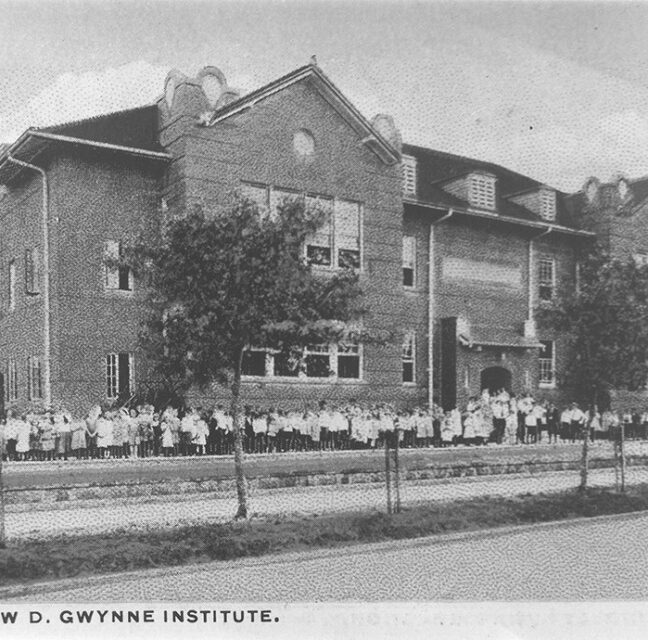
That next chapter came through Andrew D. Gwynne, a wealthy Memphis businessman and winter resident of Fort Myers who took a strong interest in local education. The Gwynne family contributed $8,000 toward construction of a modern new school. With additional community and public funding, the Andrew D. Gwynne Institute opened in October 1911. Florida Memory records describe the new school as replacing Lee County High School and serving students in grades one through twelve.
The building quickly became a center of education in Fort Myers. By 1914, enrollment growth required construction of a separate Gwynne High School, and the original Gwynne Institute became an elementary school.
The Gwynne Institute’s role in education did not end with the public schools. In 1962, the building became one of the first temporary campuses of Edison Junior College, the institution now known as Florida SouthWestern State College. Classes remained there until Edison opened its permanent Cypress Lake campus in 1965. Later, higher education in Southwest Florida expanded again with the arrival of a University of South Florida branch in Fort Myers in 1982. That branch helped establish the region’s four-year university presence and ultimately became part of the transition that led to the opening of Florida Gulf Coast University in 1997.
What began with the destruction of a simple wooden schoolhouse therefore produced consequences far beyond education. The fire exposed the frustrations of governing Southwest Florida from distant Key West, galvanized local leaders, and helped push Fort Myers toward control of its own future.
A year after the flames died out, Lee County was born.
Learn more local history at IMAG History & Science Center—where Southwest Florida’s stories come to life.
Love what you're reading?
Get the best of Fort Myers delivered to your inbox every month — local stories, events, and good news worth sharing.
Subscribe for Free