


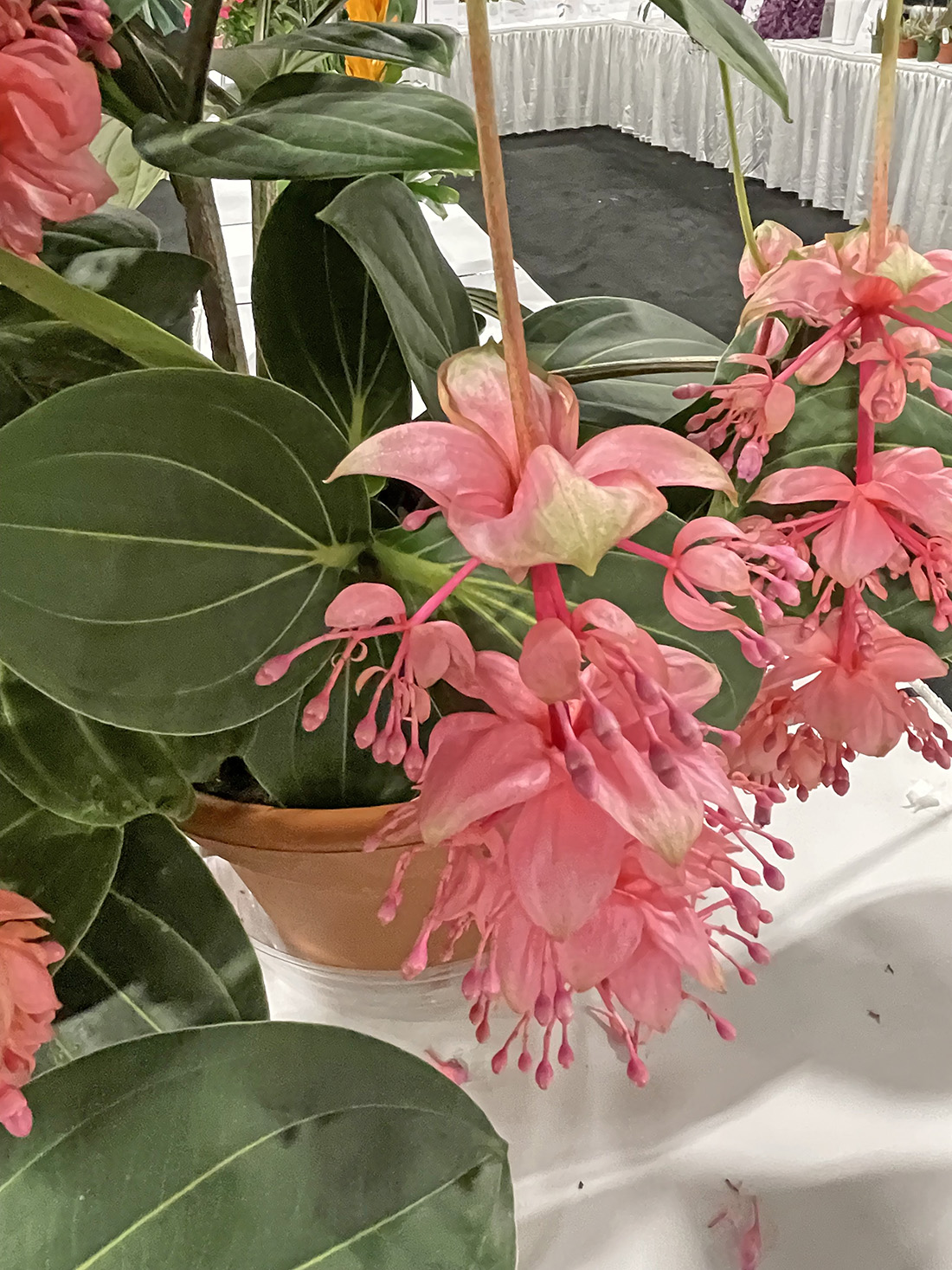
Horticultural challenges rise to the top of my list for ringing in a new year and I have a stunning one for you. Medinilla magnifica captured my fancy long ago as one of the most beautiful gifts from the tropical plant world. Not quite a set it and forget it plant, but with a thoughtful approach, featuring this stunner in your collection will bring glorious horticultural satisfaction.
Let us discuss the best approach to growing a naturally epiphytic perennial, which when properly grown, could become a pass-along generational plant. While not new to the horticulture market, Medinilla are still not common, and probably because they are a bit fussy, but I think it is more likely because they are slow growers and insist that we replicate their endemic environment to put on their best show. It takes years to propagate and raise them to a saleable size, further adding to their value.
Somewhere around 2013, we first carried the Rose Grape (not edible) or Chandelier Plant in our young Garden Shoppe and it was offered with a hefty price tag of $80. Remarkably, we did sell the few we had, and I hope they are still going strong today.
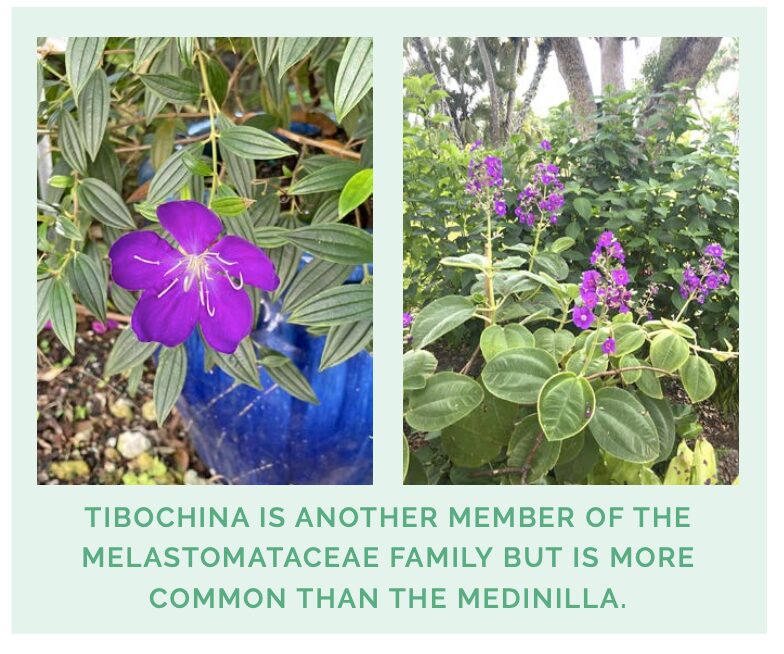
Medinilla is a member of the Melastomataceae family of 5,000+ tropical plants, and the specific genus of Medinilla has 374 recognized species according to the Royal Botanic Garden of Kew. Breaking down this horticultural mouthful, “Mela” comes from the Greek for black, probably referring to its black seeds and “stoma” or mouth for reasons I could not uncover. What truly distinguishes members of this family, though, are its highly distinctive leaves, borne opposite to each other on the stem, featuring three to seven long prominent veins that are described as acrodromous or running to a point, as they all emanate from the leaf base. Another member of this family that may be more familiar with our gardeners are the Tibochinas and if you compare the leaves of the two plants, this trait will be obvious.
Fortunately, Medinillas have come down significantly in price due to popularity and demand. Our Garden Shoppe often carries both the Medinilla magnifica known for large dark pink pendulous flowers and Medinilla myriantha (a synonym for Medinilla multiflora), which also produces pendulous arrays of pink flowers, but the Malaysian Orchid produces smaller but more flowers than its magnifica cousin.
Generally speaking, Medinillas are epiphytic plants that prefer to grow like many orchids, though they are not an orchid. When we grow them in pots, our job is to replicate the nutrients, light, drainage and humidity they would naturally receive growing in misty mountains of the tropical Philippines and throughout the Malay Archipelago. They thrive in temperatures ranging from 60 to 80 degrees. So, how are we going to do all this?
Do you own a hygrometer? Many gardeners have moisture meters to gauge water content of the soil, but we want to keep an eye on the relative humidity of the area surrounding our Medinillas. This is what a $20 hygrometer will do for you. While writing this article, I opened my weather app on my smart phone and scrolled down to “humidity,” which is reading 67%; right in the middle of the happy zone for Medinillas. Below 60%, relative humidity they will start to whine. Do you have a bathroom with a bright window? Ideal! As an epiphytic plant, we know that they receive the filtered light through the canopy of its host tree. We must provide bright, but always indirect light, to avoid scorching the beautiful Medinilla leaves. Due to the deforestation of its native habitat, Medinillas in the wild are becoming threatened.
It may sound redundant, but I want to return to the plant’s epiphytic nature again, so we can determine the best soil and water conditions to provide many happy years of growth. An acidic environment, free of any lime in the soil is perfect. It must be well drained as the roots do not want to sit in water, just as they would not while living in a tree. African violet soil is a perfect mix; or make your own with an equal mixture of peat or coco coir, perlite or pumice and clay balls to provide something for the roots to grab. Allow me a technical off-road for a moment: Medinillas are actually hemi-epiphytes, meaning they do start their life as a true epiphyte, eventually making their way to the soil, where they become long-lived perennials. Allowed to age, they produce a beautiful woody trunk, upon which companion orchids may be attached.
Re-capping, the ambient temperature and relative humidity are primary keys to success. Now on to water and fertilizing. We do want them to be thoroughly wetted, once a week or so, and the above soil recipe will afford them the necessary quick drain. Avoid using distilled water. If possible, natural rainwater is the best, but untreated tap water is okay. If the top inch feels dry to the touch, but the leaves still look perky and solid, wait one more day. These plants, like all of us, need a rest, and ideally that will be between November and February, meaning a little less water and no fertilizer. Once new growth begins to appear, use one-half the recommended amount of liquid orchid plant fertilizer (our weekly-weakly motto) on your Medinilla.
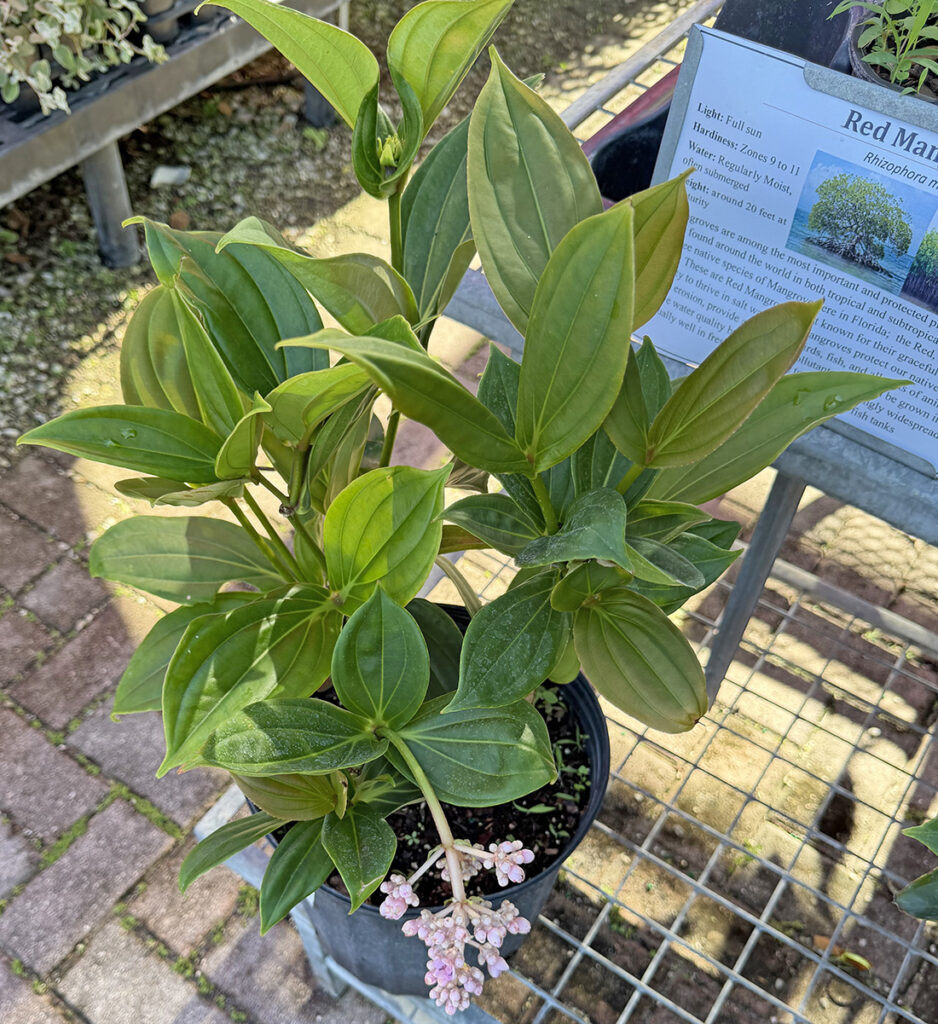
GROW LIKE MANY ORCHIDS, THOUGH THEY ARE NOT AN ORCHID. WHEN WE
GROW THEM IN POTS, OUR JOB IS TO REPLICATE THE NUTRIENTS, LIGHT, DRAINAGE AND HUMIDITY THEY WOULD NATURALLY RECEIVE GROWING IN MISTY MOUNTAINS OF THE TROPICAL PHILIPPINES AND
THROUGHOUT THE MALAY ARCHIPELAGO. THEY THRIVE IN TEMPERATURES RANGING FROM 60 TO 80 DEGREES.
The evergreen Medinilla deserves your most beautiful, large flowerpot. If grown in a 12” to 18” pot, you may only need to repot it once every two to three years and simply add a fresh top-dress of the recommended soil mixture once or twice a year. They do enjoy being slightly pot bound, but when repotting, handle the brittle roots with extreme care and always wait until it has completed blooming. To appreciate the fabulous blooms, either hang the Medinilla or stage it on a tall plantstand where its glorious flowers will droop down and astound. For a Feng Shui home, the foliage of Medinilla symbolizes prosperity and tranquility and should be near a home’s entrance.
Calatheas, marantas, ferns and alocasias make ideal companion plants to the Medinilla. Try re-purposing a big old fish tank with orchids, Cryptanthus, ferns and the dwarf Medinilla Florinilla “Arosa” to create a truly exotic terrarium.
Never be quick to cut off a spent bloom. Within its ideal surroundings, Medinilla magnifica will throw new blooms throughout its growing season, though they will not be as large as the first blooms, they are pretty, nonetheless, against its large leaves; sometimes as long as 14 inches. With proper care, the Medinilla magnifica, “Superba” and myriantha species may bloom for months at a time, and often several times a year.
As with any tropical plant, pests are inevitable. Maintaining the requisite high humidity levels will keep spider mites at bay. Should mealy bugs appear, wipe them away using Q-tips soaked in rubbing alcohol and use horticultural soaps to wash away aphids. Medinillas are non-toxic to humans, but may cause vomiting, if eaten, by domestic pets, so best to keep them out of reach of our furry buddies.
Once considered a plant only for royalty, the image of the Medinilla magnifica was included on the Belgian 10,000 Franc note, which was later replaced by the Euro. Today, treat yourself to this piece of horticultural royalty.
For other unusual plants, come to the Spring Garden Festival at Edison and Ford Winter Estates on February 14 and 15, from 9 a.m. to 4 p.m. I hope to see you there!